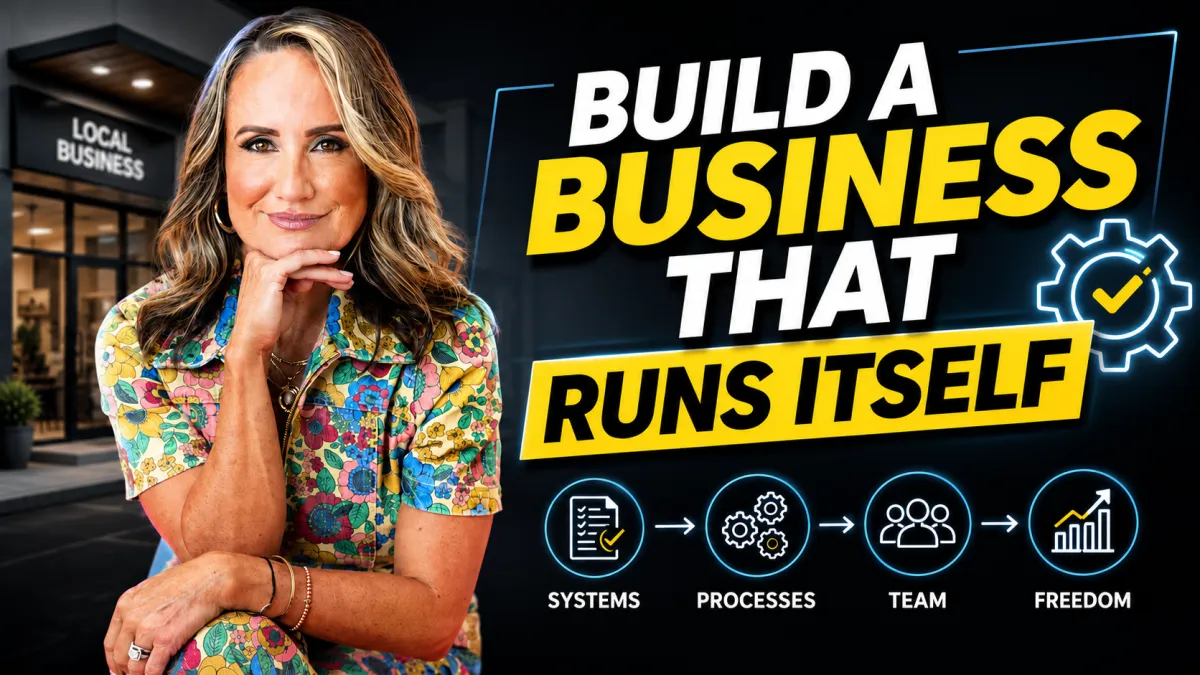
Part 1: How To Build A Local Business That Doesn't Need You Every Day
"Success isn't usually determined by the idea, it is determined by the design." - Michelle Terpstra
Most entrepreneurs don’t accidentally build bad businesses.
They build busy ones.
They build businesses that make money, but also require them to answer every call, run every errand, solve every problem, and carry every customer relationship in their head. On paper, it looks like a business. In reality, it’s often just a very demanding job with extra risk.
That’s the core question behind this episode: What if the real problem isn’t the idea, but the design?
In this episode, I break down a simple but powerful framework for evaluating whether a local business is actually worth starting. I use a senior concierge business as the example, but the bigger lesson applies to almost any service-based business: if you build it wrong, you buy yourself stress. If you build it right, you create freedom, profit, and long-term value.
Is Your Local Business a Business or Just a High-Paying Job?
The Trap Most Entrepreneurs Fall Into
When people get excited about a business idea, they usually ask the wrong question.
They ask: Can this make money?
That’s important, but it’s not enough.
The better question is: Can this create freedom and make money?
Because a business can generate revenue and still trap you inside it. That happens when everything depends on the founder. You are the salesperson, the operator, the customer service department, the delivery team, and the growth engine all at once.
That’s not freedom. That’s founder dependence.
And founder dependence is one of the fastest ways to turn a great idea into a frustrating business.
Why the Senior Concierge Business Is So Interesting
For this series, I use a senior concierge business as the model. It’s a service-based local business that helps older adults stay independent longer while giving families peace of mind.
This kind of business can include things like:
Weekly check-in visits
Grocery shopping and prescription pickup
Appointment coordination
Transportation support
Technology help
Home safety check-ins
Social connection and companionship
What it does not do is just as important. It is not home health care, nursing, assisted living, medical care, or personal care. It’s a concierge and coordination business.
Why choose this model?
Because it sits on top of a real demographic wave. More families are looking for support as aging parents need help staying at home safely and comfortably. The market is there. The demand is there. The opportunity is real.But even a great opportunity can fail if the business model is weak.
The 8-Part Business Scorecard
To evaluate the opportunity, I use a simple scorecard with eight key areas:
Founder dependence
Recurring revenue
Speed to first customer
Startup cost
Referral potential
Profit margin
AI resistance
Exit potential
If a business scores poorly in too many of these areas, it’s probably not a good business, even if it sounds exciting.
Let’s break them down.
1. Founder Dependence
This is the biggest trap.A two-out-of-ten business is one where nothing happens without the founder. No calls get answered, no services get delivered, no customers are sold, no problems get solved unless you are personally involved.
That may be necessary in the beginning. But it should never be the final design.
A ten-out-of-ten business starts with the founder involved, then quickly creates:
Standards
Training
Playbooks
Clear processes
Reliable team support
In this model, the founder owns the business. The business does not own the founder.
That’s the difference between a job and an asset.
2. Recurring Revenue
Recurring revenue is one of the strongest indicators of a healthy business.
Without it, every month starts at zero.
That creates hustle, uncertainty, and feast-or-famine stress. It also makes hiring, planning, and growth much harder.
For a senior concierge business, recurring revenue could look like monthly plans with weekly visits, family updates, errands, and coordination support. The more predictable the revenue, the more stable the business becomes.
A business built on one-off requests is harder to scale and harder to manage. A business built on recurring relationships is far more resilient.
3. Speed to First Customer
Some businesses take forever to get traction.
That’s a problem if you need cash flow soon.
A strong local business should let you get your first customer quickly without months of overbuilding. That means no wasting time on a fancy website, expensive branding, or unnecessary systems before you have proof of demand.
The fastest path is usually the simplest:
Talk to people
Show up where customers already are
Make direct offers
Start local conversations
Validate demand fast
In a local service business, sales should begin before perfection does.
4. Startup Cost
A good business should not require massive startup capital.
For this model, the goal is to keep startup costs under control and avoid expenses that don’t produce customers.That means:
No office lease
No unnecessary employees right away
No expensive software stack
No overdesigned brand identity before validation
A home-based local service business can often be started for under $1,000 if you keep it simple and practical.The point is not to be cheap.
The point is to preserve runway until customers start paying.
5. Referral Potential
Referrals can be incredibly powerful, especially in relationship-based businesses.
But referrals cannot just be hoped for. They need systems.
A weak business says, “I hope people talk about me.”
A strong business asks for referrals, builds partnerships, collects testimonials, and creates trust intentionally.
For a senior concierge business, referral partners might include:
Estate attorneys
Financial advisors
Churches
Retirement communities
Home health providers
In a trust-based business, referrals can become one of the easiest growth channels if you manage them properly.
6. Profit Margin
Service businesses often fail because they undercharge.
That usually happens when the founder wants validation before charging appropriately. But if you undercharge for too long, you burn out.
A strong model has:
Clear packages
Clear service levels
Scope boundaries
Efficient delivery
Premium pricing that matches the value delivered
The goal is to build a business that is both useful and profitable. In a strong service model, high margins are possible because the business is built around structure, not chaos.
7. AI Resistance
This one matters more than people think.
Some businesses are easy to replace with technology. Others are not.
A senior concierge business has strong AI resistance because people want human trust, human judgment, and human care when helping aging parents. That’s not something most customers want outsourced to a robot.
That said, AI can still support the business in the background:
Drafting emails
Building a website
Creating sales pages
Automating follow-up
Supporting customer service
The key is to use AI as a support tool, not a replacement for human connection.
8. Exit Potential
A business is more valuable when it does not depend entirely on the founder.
That’s what makes it attractive to buyers, investors, and roll-up strategies.
If the systems, contracts, training, and customer relationships all live inside the founder’s head, the business is hard to sell.
If the business has:
Recurring contracts
Repeatable systems
Documented processes
A trained team
A management layer beyond the founder
then the business becomes much more valuable.
That’s not just good for an exit someday. It’s good for your business now.
The Real Lesson: Design Beats Idea
The most important lesson from this episode is simple:
Success is usually determined less by the idea and more by the design.
A senior concierge business can be a two-out-of-ten business or a ten-out-of-ten business.
Same market. Same category. Same customer.
Different outcome.
The difference is whether the business is designed to create freedom or to trap the founder in a new job.
That’s the challenge I want every entrepreneur to think about before they start anything new.
Final Takeaway
If you’re starting a local business, or reworking one you already own, ask yourself:
Does this depend too much on me?
Does it create recurring revenue?
Can I get customers quickly?
Is startup cost reasonable?
Can referrals grow it naturally?
Is the margin strong?
Is it resilient to AI disruption?
Could someone actually buy this someday?
If the answer to those questions is mostly yes, you may have a real business.
If not, you may have built yourself a job.And that’s exactly what this series is here to help you avoid.
In the next episode, the focus shifts to getting the first 10 customers, because once the model is right, growth becomes much easier.
To gain complimentary access to ALL workbooks, scrips, and playbooks that Michelle discusses on the Revenue Rascals Podcast, fill out the form below. It's just a one-time sign up and SUPER easy.


