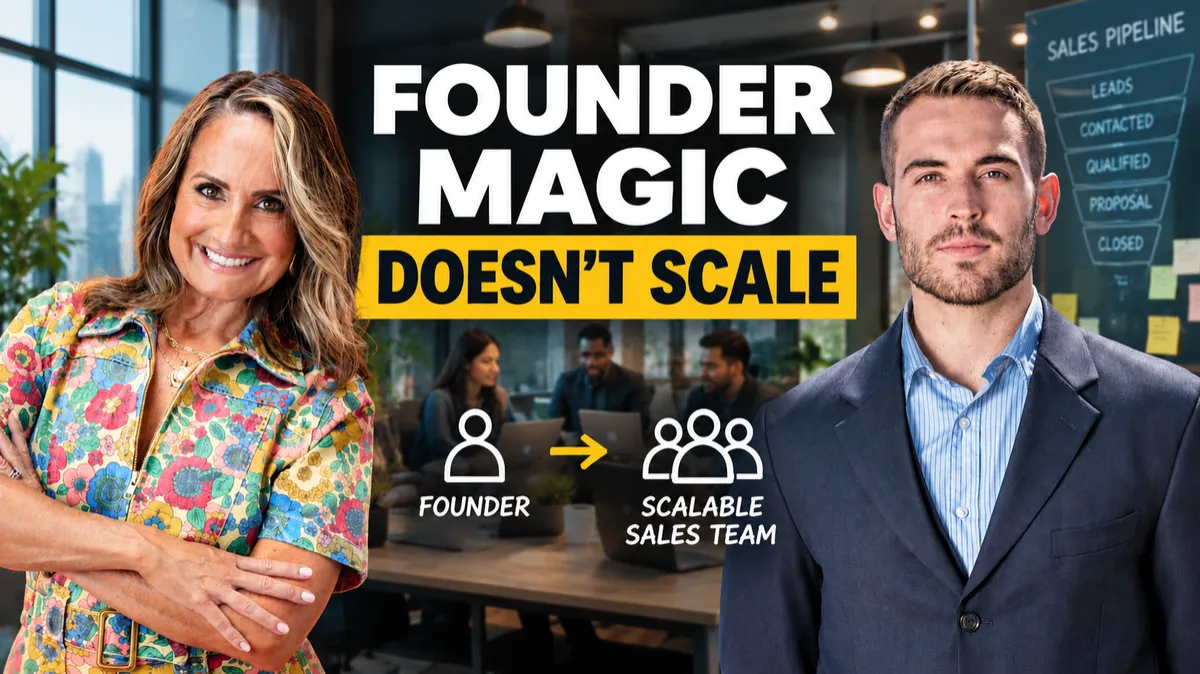
From Founder Magic to a Scalable Sales Team | Michelle Terpstra on Acquisition HQ
"Founder magic doesn't automatically transfer to new hires." - Michelle Terpstra
For many founders, becoming the company's best salesperson is part of what gets the business off the ground. You know the product inside and out. You understand your customers. You can tell when a prospect is ready to buy, handle objections naturally, and close deals because you believe in what you're selling.
But what happens when the business grows?
Suddenly, the very thing that helped you succeed can become the thing holding you back.
If every major opportunity requires your involvement, every difficult conversation lands on your desk, and every new salesperson eventually needs you to step in and close the deal, you haven't built a sales organization that can operate independently. You've built a business that depends on you.
In this week's episode of the Revenue Rascals Podcast, Michelle Terpstra takes a turn on the other side of the microphone, sharing a recent interview with Nathan Byrd on the Acquisition HQ Podcast.
The conversation explores a challenge familiar to many growing businesses: how to turn the founder's natural sales ability into a repeatable process that a team can execute, improve, and scale.
From Founder Magic to a Scalable Sales Team: How to Grow Beyond Founder-Led Sales
Here's what founders need to understand about moving beyond founder-led sales.
1. Founder Magic Isn't a Sales Process
Founders often have an incredible instinct for selling.
They know which questions to ask, how to build trust, when to push forward, and when to give a prospect space. They understand the nuances of the product and can connect its value directly to a customer's needs.
The problem? Much of that knowledge may exist only in the founder's head.
A new salesperson can't simply observe a few calls and automatically replicate years of experience, intuition, and customer understanding.
That's why hiring a salesperson doesn't necessarily solve the founder's sales problem.
You can't delegate a process that hasn't been defined.
To build a sales team that can operate without constant founder involvement, you need to identify what actually makes your sales approach work.
That means documenting and clarifying things like:
Who your ideal customers are and how to recognize them.
What problems your product or service solves.
Which questions help uncover a prospect's real needs.
How your team should communicate value.
How to handle common objections.
What qualifies a prospect as a real opportunity.
What needs to happen at each stage of the sales process.
When a salesperson should make a decision independently and when to escalate.
The goal isn't to turn every salesperson into a scripted version of the founder.
It's to give them the knowledge, structure, and confidence to succeed without needing the founder to rescue every deal.
2. Revenue Problems Don't Always Start in Sales
When revenue slows down, the instinct is often to look at the sales team.
Are the reps closing enough deals? Do they need more training? Should you hire another salesperson? Is the team working hard enough?
Those questions may be relevant, but they don't tell the whole story.
Revenue depends on how different parts of the business work together. Marketing creates awareness and generates interest. Sales turns qualified opportunities into customers. Customer success helps customers realize value, remain engaged, and continue their relationship with the business.
When those functions aren't aligned, problems can appear throughout the customer journey.
Marketing might generate leads that don't match the ideal customer profile. Sales might be working with messaging that doesn't reflect what marketing promised. Customer success might discover that customers have expectations the sales team never addressed.
The result can be wasted time, frustrated teams, lost opportunities, and inconsistent revenue.
Instead of assuming the sales team is the problem, founders should examine the entire revenue process.
Ask yourself:
Are we attracting the right customers?
Are marketing and sales aligned on what makes a lead qualified?
Does the sales team understand the promises being made before a prospect becomes a customer?
Are customers receiving the value they expected?
Are we using feedback from existing customers to improve how we sell?
A predictable revenue engine requires more than good salespeople. It requires the entire customer journey to work together.
3. AI Should Support the Sales Team, Not Replace the Human Connection
AI is changing how sales organizations operate, but adding new technology doesn't automatically create a better sales process.
The important question isn't simply, "Where can we use AI?"
It's, "Where can AI remove friction and help our people do their jobs more effectively?"
Salespeople spend time on activities that don't always require their full expertise or personal attention. Administrative work, information gathering, repetitive tasks, and certain forms of follow-up can consume hours that might otherwise be spent with customers.
AI can help reduce some of that burden.
But the human side of selling still matters.
Understanding a customer's priorities, building trust, navigating complex decisions, and having meaningful conversations require more than automating a sequence of tasks.
Founders should think strategically about where technology belongs in their sales organization.
Consider:
Which repetitive tasks could be streamlined?
Where does your team spend time gathering or organizing information?
Which activities genuinely benefit from a salesperson's judgment and experience?
Are your tools helping people sell, or simply creating more work?
How can technology support better customer conversations rather than make them feel impersonal?
The objective is not to introduce AI for the sake of having AI.
It's to create a sales organization where technology handles appropriate work and people can focus on the activities where their skills make the greatest difference.
4. Building Beyond the Founder Requires More Than Hiring
Hiring a salesperson is a decision. Building a sales organization is a process.
A founder who wants to step out of the sales seat needs to think about what the business will require once they're no longer personally managing every opportunity.
That includes the systems, expectations, leadership, and accountability that allow the team to function consistently.
Without those foundations, a founder may find themselves pulled right back into the same responsibilities they were trying to delegate.
A scalable sales organization needs clarity around:
Roles and responsibilities: Everyone should understand what they're accountable for and where their responsibilities begin and end.
Sales processes: The team needs a shared understanding of how opportunities move through the pipeline and what successful execution looks like.
Performance visibility: Leaders need meaningful information about pipeline health, sales activity, conversion, and results.
Coaching and development: Salespeople need feedback and guidance that help them improve rather than simply being told to hit a number.
Leadership structure: As the team grows, someone needs to own the sales process, support the people executing it, and maintain accountability.
The founder's job changes as the company grows.
Instead of being the person who personally makes every sale happen, the founder needs to build an environment where the right people can consistently make sales happen.
5. Reducing Founder Dependency Can Change the Value of a Business
A business that relies heavily on its founder can be difficult to scale.
It can also create challenges when the founder wants to pursue other opportunities, take a step back from daily operations, or eventually sell the company.
If customer relationships, sales knowledge, and the ability to close important deals are concentrated in one person, that dependency becomes an important consideration for the business.
Reducing founder dependency means building capabilities that exist beyond the founder.
That includes developing a sales process others can execute, creating a team with clearly defined responsibilities, and establishing leadership and systems that support consistent performance.
This doesn't mean the founder becomes irrelevant.
Founders can continue to contribute through strategy, product direction, key relationships, and leadership. The difference is that the business no longer needs the founder to personally carry every important sales responsibility.
The long-term objective is to build a company that can continue creating value without requiring the founder to be involved in every transaction.
For founders thinking about growth, succession, or a future exit, that distinction matters.
The Bottom Line: Build a Business That Doesn't Need You to Close Every Deal
Founder-led sales can be an important part of a company's early success.
But if the business is going to grow beyond that stage, the founder's sales ability needs to become something the organization can learn, execute, and improve upon.
That requires more than another hire.
It requires a clear sales process, alignment across marketing and customer success, thoughtful use of AI, and a team structure that supports accountability and leadership.
The question isn't whether you can sell.
The question is whether you've built a sales organization that can succeed when you're not the one doing the selling.
If you're ready to move beyond founder-led sales, start by identifying what only you know, what only you do, and what your team needs in order to take ownership.
That's where the transition from founder magic to a scalable sales team begins.
To gain complimentary access to ALL workbooks, scrips, and playbooks that Michelle discusses on the Revenue Rascals Podcast, fill out the form below. It's just a one-time sign up and SUPER easy.
Frequently Asked Questions
1. What is founder-led sales?
Founder-led sales is when a company's founder personally drives most or all of its sales activity, including building relationships, managing opportunities, and closing deals. It can be effective in the early stages of a business, but it can become a bottleneck as the company grows.
2. Why can founder-led sales become a problem as a business scales?
When every important deal depends on the founder, growth becomes limited by that person's time and availability. The business may struggle to increase sales capacity, delegate responsibilities, or operate independently.
3. How can a founder transition out of the sales role?
Start by documenting the sales process, clarifying the ideal customer profile, defining qualification criteria, and establishing repeatable methods for handling opportunities. Then hire and develop the right people, provide coaching, and gradually transfer responsibility.
4. Why isn't hiring a salesperson enough to solve a sales problem?
A salesperson needs more than a job description and a revenue target. Without a clear process, effective training, defined expectations, and ongoing leadership, the new hire may struggle to reproduce the founder's results.
5. What does a scalable sales process look like?
A scalable sales process is clearly defined, repeatable, measurable, and teachable. It helps the team understand how to identify prospects, qualify opportunities, communicate value, manage the pipeline, and move deals toward a decision.
6. How do marketing and sales alignment affect revenue growth?
When marketing and sales agree on the ideal customer, lead qualification, messaging, and expectations, they can work together more effectively. Misalignment can result in poor-quality leads, inconsistent messaging, wasted resources, and lost opportunities.
7. How can AI help a sales team become more efficient?
AI can help streamline appropriate administrative and repetitive tasks, organize information, and reduce time spent on routine work. The goal is to give salespeople more time to focus on customer relationships, meaningful conversations, and activities that require human judgment.
8. Does building a scalable sales team mean the founder should stop selling completely?
Not necessarily. Founders can remain involved in strategy, important relationships, and selected opportunities. The key is to avoid making the founder the required participant in every deal.
9. How does reducing founder dependency affect a business?
Reducing founder dependency can help a business operate more consistently, increase its capacity for growth, and become less reliant on one person's time and knowledge. It can also be an important consideration when planning succession or a potential business sale.
10. What is the first step toward building a sales team that can scale?
Identify which sales activities currently depend on the founder. Determine what knowledge, processes, and decisions need to be transferred to the team, then begin documenting and systematizing those activities.
Summary
In this episode of the Revenue Rascals Podcast, Michelle Terpstra explores how founders can move beyond founder-led sales and build a scalable sales team. The conversation covers the importance of creating repeatable sales processes, reducing founder dependency, aligning marketing and sales, and using AI to streamline operations. The goal is to help founders build a sales organization that can consistently generate revenue without relying on the founder to close every deal.


